Admin debt: the silent tax on every growing company
Every uncategorised receipt, every board decision made over coffee, every contract still waiting to be filed. It compounds quietly – until DD opens, or the tax authority asks a question you can't answer in five minutes.
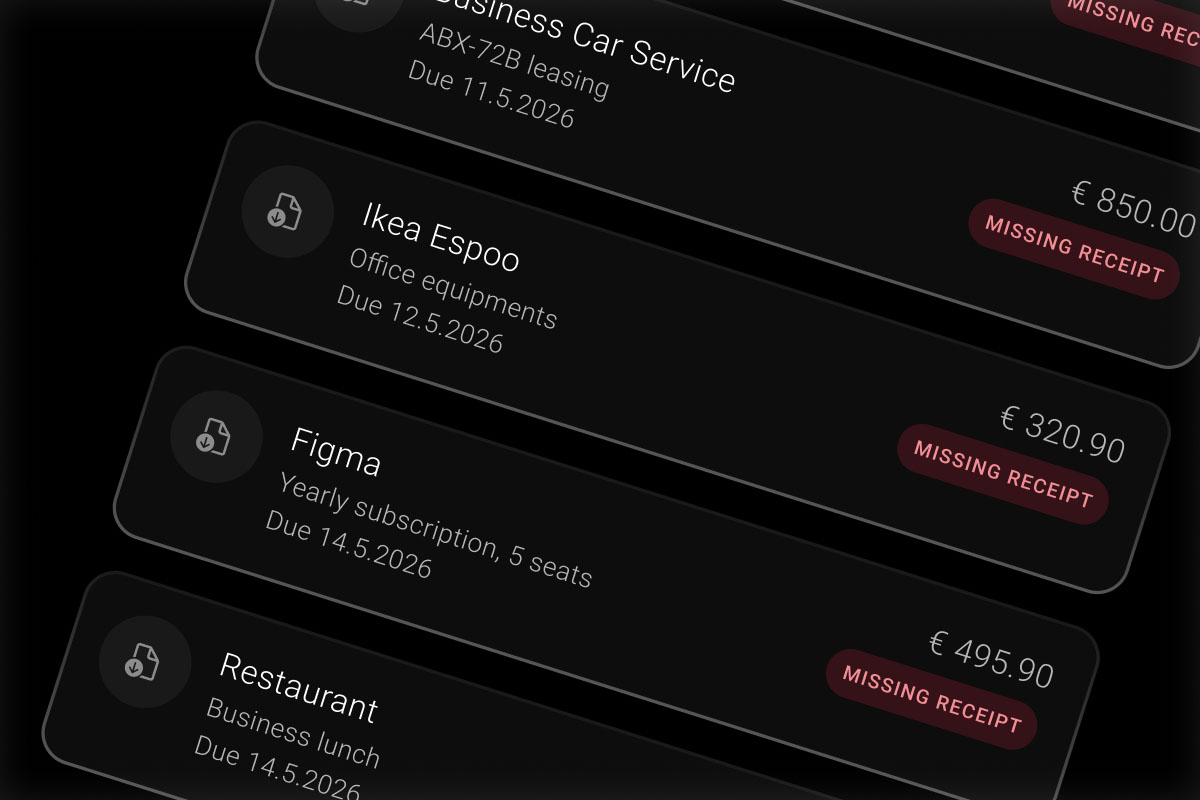
It's Sunday evening. A stack of receipts from three trips, two months of card statements, and an Excel sheet that hasn't been opened since February. Tomorrow your accountant needs the VAT numbers. You promised yourself last quarter you wouldn't let it pile up again.
Welcome to admin debt.
It's more than receipts
Admin debt is the gap between what your business has done and what its records say it has done. Every receipt still in a pocket. Every invoice not yet categorised. Every contract waiting to be filed. And — the part most founders forget until it's too late — every board decision made over coffee that never got written up.
It has three faces.
The real cost of doing things later. Filing a receipt today takes 15 seconds. Filing it six weeks from now takes 20 minutes — you have to remember the trip, find the project, reconstruct the context. Retroactive work is multiples more expensive than work done in the moment.
Missing corporate paperwork. The board approved a €50k shareholder loan in March — no written resolution. The CTO's raise went into payroll in April — no board minute. The option grant promised to the new hire still doesn't have a decision behind it. None of this is malicious; it's the natural consequence of running a fast company. But when due diligence opens, or the tax authority asks why a loan is on the books, the absence of verified documentation turns a five-minute conversation into a six-week problem.
The quiet anxiety. Nagging VAT deadlines. Background worry about whether last quarter's books are right. Low-grade fear of an audit, or a DD process, that you can't actually prepare for because you don't fully know what's in there.
Admin debt is what compounds while you're doing the work you actually started the company to do.
Why even careful founders carry it
No founder sets out to accumulate admin debt. The system around them assumes it will.
Financial admin is designed to land after the fact. Receipts arrive after the meal. Invoices arrive after the work. The accountant asks questions three weeks after the transaction. Every piece of it is retrospective — and retrospective tasks are the ones humans push to later.
The tools fragment the work. Bank in one place. Invoicing in another. Expenses somewhere else. Receipts buried behind a login on Stripe, AWS, and every SaaS subscription since 2023. You're the human integration layer between six systems that don't talk.
Governance happens in conversation. A board call. A founder lunch. A WhatsApp at 9pm: "yep, fine, let's do it." The decision is real; the paper trail isn't. Shareholder loans, option grants, salary changes, related-party transactions — each needs a written resolution to be defensible. When an investor opens a data room and asks where is the board decision?, the silence is what costs you.
Usual fixes don't work
A better accounting firm changes who chases you for the receipts. It doesn't change the fact that they still need chasing.
Better accounting software gives you a more polished cockpit for a job you didn't want in the first place. Xero, Procountor, the rest — they're tools, and tools assume someone is using them. That someone is still you.
"We'll catch up at year-end" is the most expensive option of all. Six weeks of context loss, multiplied by a year of transactions, equals a January your team won't forget.
None of these fixes admin debt — because admin debt isn't caused by the wrong tool or the wrong firm. It's caused by the assumption that financial admin is something the business owner does at all.
Done as it happens
Rise starts from a different assumption: if a process can be done as it happens, it should be — and it should happen without you.
AI first. A team of AI agents watches your transactions, your inbox, your calendar, and your card. A receipt arrives at 11pm on a Tuesday. It's categorised, matched, and booked before you've finished brushing your teeth. 95% of the manual work is gone. Invoices land in the ledger in under 4 seconds.
Mobile second. When something needs a human decision — an unusual expense, a new vendor, an approval — it shows up on your phone as a swipe. Not a form. Not a login. A swipe.
Accountant third. KLT-qualified accountants review the AI's work. They catch the edge cases and own the compliance posture. The human is on the hook for quality — so the books aren't probably right, they are right. No single point of failure, no summer holiday gap.
The same logic extends to corporate records. The board approves a shareholder loan? The decision gets captured, drafted into a resolution, signed, and filed against the transaction at the moment it's made. Salary changes, option grants, related-party transactions — each one gets the paper trail it needs. When DD opens, the data room is already populated.
The result: admin debt doesn't accumulate. Today's P&L is actually today's. The audit trail covers 100% of the transactions. The Sunday-evening reconstruction session disappears, because there's nothing to reconstruct.
When everything is captured and processed as it happens, there is no backlog to dread.
What it's costing you right now
If you're running a 10–30 person consultancy, the question isn't whether you have admin debt. You do. The question is what it's costing you — in evenings, in stale numbers, in board resolutions that don't exist yet, in the quiet confidence drain you've stopped noticing.
Your time is worth €300–500 an hour. A Sunday on expenses is a four-figure mistake. A board meeting with last month's numbers is worse. A funding round with a half-empty data room is worse still.
There is now a category of service that assumes none of that work should be yours. AI does it. Certified accountants make sure it's right. You run your business.
---
We may have room for a few more founding customers. One conversation to find out.
Book 30 minutes with Jani: jani@risegroup.eu · +358 44 776 7828